

|
Getting your Trinity Audio player ready...
|
To judge Ghanaian pop music solely by its ability to fill dancefloors is to miss the bigger picture. It creates a shallow measure of success, one where artists with forgettable lyrics or an endless catalogue of lust-driven anthems can rack up hits and, years later, return demanding recognition as cultural icons.
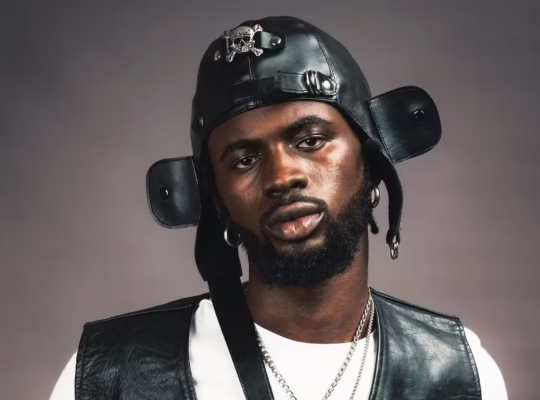
Thankfully, Black Sherif has never belonged to that crowd.
Since bursting onto the scene as a teenager, he has consistently stretched the boundaries of contemporary Ghanaian music, blending raw storytelling with emotional depth. Yet recent conversations around his music have grown increasingly sceptical. Some critics argue that the fiery intensity which powered breakout records like First Sermon and Second Sermon has faded.
That assessment says more about how audiences consume Ghanaian pop than it does about Black Sherif himself.
At just 24, the two-time Artiste of the Year winner, and the youngest to achieve the feat, has never abandoned the artistic foundation that made him compelling. If anything, he has refined it. While his sound has evolved, his connection to highlife remains intact. It continues to serve as the spiritual backbone of his music.
His sophomore album, Iron Boy, wears that influence proudly. From its title-track homage to highlife legend Amakye Dede to its rich instrumentation, vocal textures and reverence for musical heritage, the album is deeply rooted in tradition while still looking ahead.
The signs are all there in songs like Popstar and the hypnotic SWAGGA. These are records that resist easy categorisation as mere dance tracks. They demand a different kind of listening, one that engages the mind as much as the body.
Black Sherif’s music has never been designed for fleeting consumption. Its rewards reveal themselves over time through repeated listens and deeper reflection. His most loyal fans understand this. The question is whether casual listeners are willing to meet the music halfway.
This latest version of Black Sherif is not retreating from relevance. He is redefining it. The rough-edged street energy of his early years may have softened, but the qualities that made him essential remain firmly in place: honesty, vulnerability, introspection and emotional weight.
His songs continue to function as companions for difficult moments, offering reflection and, for many listeners, a measure of comfort.
As he boldly reminds listeners on SWAGGA, “We be the geniuses, please, please, I’m serious.” It is a line that feels less like a boast and more like a statement of intent.
His surprise release, Find A Way, produced alongside longtime collaborators Joker Nharnah and Samsney, reinforces that idea. Driven by triumphant horns and themes of perseverance, the track feels like an anthem for resilience, a fitting soundtrack for a period defined by ambition and possibility.
More importantly, it captures the essence of Black Sherif’s journey: an artist who continues to evolve while remaining firmly connected to the values and experiences that shaped him.
That, after all, is the enduring story of great art and of those rare artists bold enough to pursue greatness.